
Need to know how much crushed stone your project requires? Use our Crushed Stone Calculator to estimate the amount of material needed based on your project’s length, width, depth, and the bulk density of the stone.
You can use the results to estimate cubic yards, tons, and material costs for projects such as driveways, walkways, patios, drainage areas, and aggregate bases.
Crushed Stone Calculator
Estimate the amount of crushed stone you need in cubic yards and tons, along with an optional material cost estimate.
Optional Cost Estimate
Quick Answer: To find the volume of crushed stone, multiply the length by the width and depth. If the depth is measured in inches, convert it to feet first. Divide the cubic feet by 27 to calculate the volume in cubic yards. To estimate the weight in tons, multiply the cubic yards by the material’s bulk density.
How to Use a Crushed Stone Calculator
Using a Crushed Stone Calculator is straightforward. You’ll need three basic measurements:
- Area length
- Area width
- Stone layer depth
Additionally, if you want to convert the calculated volume into tons, you’ll also need the bulk density of the material.
For a cost estimate, enter the price per ton or per cubic yard provided by your local stone supplier.
For the most accurate estimate, use the bulk density provided by the quarry or aggregate supplier rather than relying on a general or standard density value.
Crushed Stone Calculation Formula
The calculation starts with determining the volume of crushed stone needed for your project.
- Calculate the Area
Area = Length × Width
If your measurements are in feet, the result will be in square feet.
- Convert Depth to Feet
If your stone depth is measured in inches:
Depth in Feet = Depth in Inches ÷ 12
- Calculate Cubic Feet
Cubic Feet = Length × Width × Depth
- Convert Cubic Feet to Cubic Yards
Cubic Yards = Cubic Feet ÷ 27
There are 27 cubic feet in one cubic yard. This is a volume conversion; it does not indicate how much the crushed stone weighs.
- Estimate Tons
Tons = Cubic Yards × Bulk Density
Bulk density is important because different types of crushed stone can have different weights per cubic yard. Therefore, using the correct density for your specific stone material will give you a more accurate weight estimate.
Crushed Stone Calculator Example
Let’s say you want to cover an area that is:
25 feet long
12 feet wide
5 inches deep
First, calculate the area:
25 × 12 = 300 square feet
Convert the depth to feet:
5 ÷ 12 = 0.4167 feet
Now calculate the volume:
300 × (5 ÷ 12) = 125 cubic feet
Convert the volume to cubic yards:
125 ÷ 27 ≈ 4.63 cubic yards
So, you’ll need approximately 4.63 cubic yards of crushed stone before allowing for any additional material or waste.
If your supplier’s material has a bulk density of 1.4 tons per cubic yard:
4.63 × 1.4 ≈ 6.48 tons
Therefore, this project would require approximately 6.48 tons of crushed stone at that bulk density.
Keep in mind: The 1.4 tons per cubic yard value is only an example. The actual bulk density can vary depending on the type, size, and composition of the crushed stone you use.
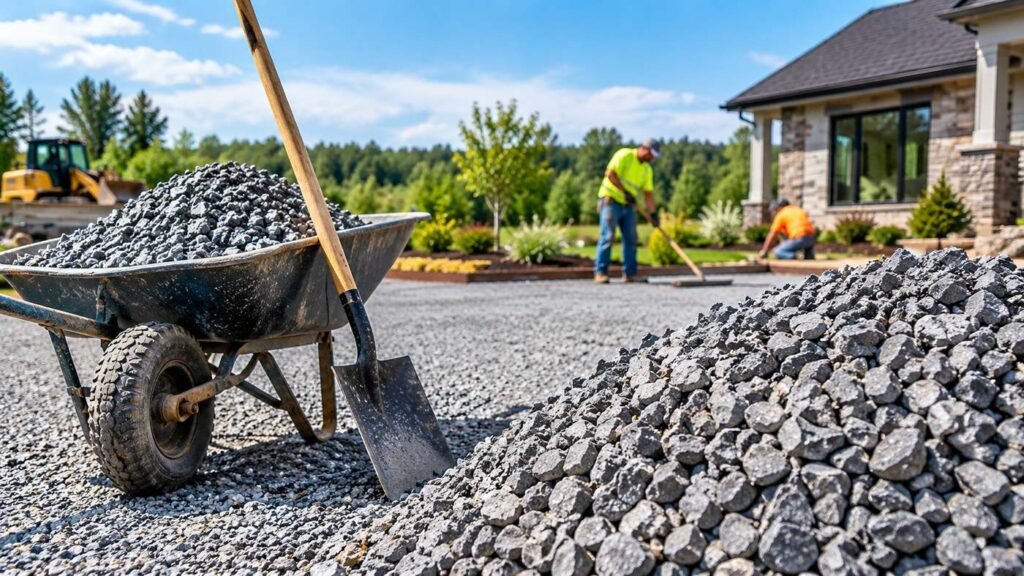
How Many Tons of Crushed Stone Do I Need?
The amount of crushed stone you need depends on the total volume of your project and the bulk density of the material. A crushed stone calculator can help you estimate the number of tons required based on your project’s dimensions and the material’s density.
For example, if your project requires 8 cubic yards of crushed stone:
| Bulk Density | Estimated Weight |
| 1.25 tons/yd³ | 10.00 tons |
| 1.35 tons/yd³ | 10.80 tons |
| 1.45 tons/yd³ | 11.60 tons |
| 1.55 tons/yd³ | 12.40 tons |
| 1.65 tons/yd³ | 13.20 tons |
As you can see, you should not assume that every cubic yard of crushed stone weighs the same. The weight can vary depending on the type and density of the material.
If your supplier provides a bulk density or weight per cubic yard, use that specific value in the calculator for a more accurate estimate.
How Many Cubic Yards Are in a Ton of Crushed Stone?
The answer depends on the bulk density of the crushed stone material.
For example, if a particular stone weighs 1.4 tons per cubic yard:
1 ÷ 1.4 = 0.71 cubic yards per ton
So, one ton of this material would occupy approximately 0.71 cubic yards.
For this reason, you should not treat this conversion as a fixed value because different types and sizes of crushed stone can have different bulk densities.
What Is Crushed Stone?
Crushed stone is produced by mechanically crushing larger pieces of rock into smaller particles. Depending on the product, crushed stone can include a range of particle sizes, from larger angular pieces to smaller particles and stone dust.
Crushed stone is commonly used for:
- Driveways
- Walkways
- Patios
- Drainage systems
- Construction bases
- Road bases
- Landscaping
- Pipe bedding
- Concrete and asphalt applications
- Filling and leveling
The best material for a project depends on its specific requirements. Particle size, grading, durability, drainage characteristics, and compaction behavior can vary between different crushed stone products, so choosing the right material is important for achieving the desired results.
Crushed Stone vs. Gravel
Crushed stone and gravel are both commonly used for driveways, walkways, drainage, and landscaping projects. However, they differ in how they are formed and processed. Crushed stone is produced by mechanically breaking larger rocks into smaller pieces, giving it angular edges that help the material lock together. Gravel often contains naturally weathered or rounded stones, although its shape and texture can vary.
As a result, crushed stone is often a good choice for compacted bases and surfaces that need stability, while rounded gravel may be preferred for decorative landscaping and some drainage applications. The best option depends on your project requirements, stone size, drainage needs, and local material availability.
Common Types of Crushed Stone
Different projects require different types of aggregate, depending on how the material will be used.
#57 Stone
#57 stone is a commonly used coarse aggregate. It is often used for drainage, landscaping, concrete applications, and other projects that require a relatively coarse material.
#8 Stone
#8 stone is smaller than #57 stone and is commonly used for walkways, bedding, and other applications where a smaller aggregate is needed.
#4 Stone
#4 stone is a larger aggregate commonly used for drainage, fill, base layers, and other construction applications.
Crusher Run
Crusher run, also known as dense-graded aggregate in some areas, contains a mixture of stone sizes and fines. This combination allows it to compact into a relatively dense and stable surface.
Stone Dust or Screenings
Stone dust and screenings are fine aggregate materials commonly used for bedding, leveling, and finishing applications.
Important: Product names and specifications can vary by region and supplier. Always confirm the exact material and specifications before ordering.
Clean Stone vs. Crusher Run
One important difference to understand when buying crushed stone is whether you need clean stone or a dense-graded material such as crusher run.
Clean stone contains little or no fine material, which leaves more open space between the larger particles. This makes some types of clean stone a good choice for drainage applications.
In contrast, crusher run contains a mix of different particle sizes and fines. When compacted, the smaller particles fill the spaces between the larger pieces, creating a denser and more stable layer.
These materials are not always interchangeable.
If your project requires good drainage, a compactable base, or a specific structural layer, choose the material based on the project’s requirements rather than simply choosing the least expensive aggregate.
How Much Crushed Stone Do I Need for a Driveway?
To estimate how much crushed stone you need for a driveway, measure:
- Driveway length
- Driveway width
- Required aggregate depth
- Material type
- Material density
For example, consider a driveway that is 14 feet wide and 50 feet long with a 5-inch aggregate layer.
Area
14 × 50 = 700 square feet
Depth
5 ÷ 12 = 0.4167 feet
Volume
700 × 0.4167 ≈ 291.67 cubic feet
Cubic Yards
291.67 ÷ 27 ≈ 10.80 cubic yards
Therefore, the driveway would require approximately 10.80 cubic yards of crushed stone for this single 5-inch layer, before adding any extra material for waste or additional coverage.
Additionally, if the driveway has separate base and surface layers, calculate the material needed for each layer separately.
How Much Crushed Stone Do I Need for a French Drain?
A French drain requires more planning than simply filling a trench with crushed stone.
You may need to consider:
- Trench length
- Trench width
- Stone depth
- Drain pipe diameter
- Pipe placement
- Filter fabric
- Drainage slope
- Soil conditions
- Outlet location
However, use a Crushed Stone Calculator to get a practical estimate of stone needed, but it cannot determine whether the drainage system has the proper slope, outlet, pipe size, or overall design.
For drainage projects, use the appropriate project specifications and follow any local requirements.
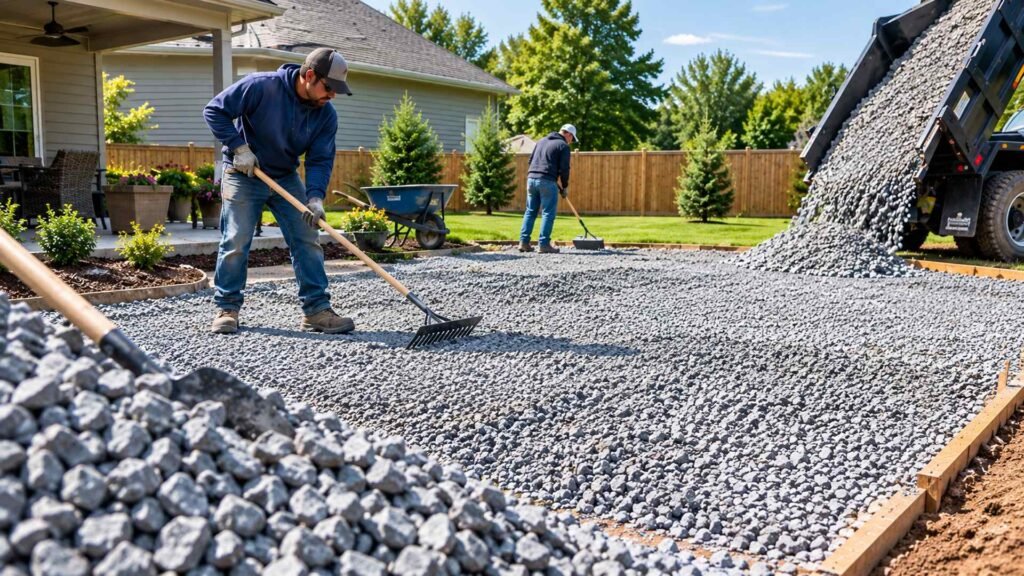
How Much Crushed Stone Do I Need for a Patio or Walkway?
Start by calculating the total area:
Length × Width = Square Feet
Then multiply the area by the required stone depth.
For example, suppose a walkway is 6 feet wide and 35 feet long:
6 × 35 = 210 square feet
At a depth of 3 inches:
210 × (3 ÷ 12) = 52.5 cubic feet
Then:
52.5 ÷ 27 = 1.94 cubic yards
So, before adding any extra material, the project would require approximately 1.94 cubic yards of crushed stone.
If you are using crushed stone as a base for a concrete project, our Concrete Slab Cost Calculator can help you estimate the concrete quantity and overall project cost.
Should You Add Extra Crushed Stone?
You may want to order a little more material than the exact geometric calculation requires.
An extra allowance may account for:
- Uneven ground
- Spillage
- Irregular edges
- Handling losses
- Minor measurement errors
- Site conditions
A 10% allowance is often used as a general planning estimate, but it is not a universal rule.
For example, if your calculated material requirement is 4.8 cubic yards:
4.8 cubic yards × 1.10 = 5.28 cubic yards
However, do not automatically treat the 10% allowance as a compaction factor. The amount of loose material needed to achieve a specific compacted depth can vary depending on the material and installation method.
For larger or more technical projects, ask your supplier or contractor how much loose material is appropriate for the finished depth you need.
Compacted Depth vs. Loose Depth
This is an important detail that can affect how much material you need to order.
Suppose your project specifications call for a 4-inch compacted aggregate layer.
That does not necessarily mean you should simply enter 4 inches and assume the delivered loose material will result in exactly that finished depth.
Compaction changes the volume of the material.
For a basic material estimate, use the project’s required finished depth. Then, if compaction is involved, confirm with your supplier or installer how much loose material is needed to achieve the desired compacted depth.
This is especially important for:
- Driveway bases
- Road bases
- Structural aggregate
- Dense-graded materials
- Projects with specific compaction requirements
How Much Does Crushed Stone Cost?
The cost of crushed stone can vary depending on several factors, including:
- Type of material
- Location
- Quantity ordered
- Supplier
- Delivery distance
- Whether the material is sold by the ton or cubic yard
- Minimum order requirements
If you are given a price per ton:
Material Cost = Tons × Price per Ton
If you are given a price per cubic yard:
Material Cost = Cubic Yards × Price per Cubic Yard
Your final delivery cost may also include:
- Delivery fees
- Minimum load charges
- Taxes
- Special product charges
- Other supplier fees
For this reason, a Crushed Stone Calculator should be used as a planning estimate rather than a guaranteed quote from a supplier.
How to Get a More Accurate Crushed Stone Estimate
Before placing your order, ask your supplier these questions:
- What is the exact product name?
- What is the bulk density of the material?
- Is it sold by the ton or cubic yard?
- What is the minimum order?
- How much material should I order for my finished depth?
- What is the delivery charge?
- Does the quoted quantity refer to loose or compacted material?
As a result, getting these details from your supplier can make your estimate much more accurate than relying on a general density or price.
How to Calculate Crushed Stone for an Irregular Area
Not every project has a simple rectangular shape.
If your area has multiple sections, divide it into smaller shapes and calculate each section separately.
For example:
- Section A: 18 × 12 feet
- Section B: 14 × 9 feet
- Section C: 8 × 6 feet
Next, calculate the volume for each section, then add the results together.
For a circular area:
Area = π × Radius²
Then:
Volume = Area × Depth
Similarly, for projects with multiple aggregate layers, calculate the material needed for each layer separately.
This method is usually easier and more accurate than trying to estimate an irregular area as one large rectangle.
Common Crushed Stone Calculation Mistakes
Using Inches Without Converting Them
If your length and width are measured in feet but the depth is in inches, divide the depth by 12 before calculating the volume.
Confusing Cubic Yards With Tons
Cubic yards measure volume, while tons measure weight.
Density is what connects the two measurements.
Using the Wrong Density
Different crushed stone products can have different bulk densities, so using the wrong value can affect your estimate.
Treating All Crushed Stone the Same
#57 stone, crusher run, screenings, and other aggregates can have different characteristics and uses.
Adding Too Much Extra Material
An allowance can be helpful, but automatically adding a large percentage may increase your order unnecessarily.
Calculating Multiple Layers Together
If a project has a base layer and a separate surface layer, calculate the amount needed for each material separately.
Forgetting Delivery
The material price may not include delivery charges, which can add to the total project cost.
Ignoring the Subgrade
A Crushed Stone Calculator can estimate the amount of aggregate needed, but it cannot determine whether the underlying soil or subgrade is suitable for your project.
What Information Do You Need to Use a Crushed Stone Calculator?
For a basic calculation, you’ll need:
- Length
- Width
- Depth
- Unit of measurement
- Stone or aggregate type
- Bulk density
- Material allowance, if applicable
- Price, if estimating the cost
For more complex projects, you may also need:
- Number of separate areas
- Number of aggregate layers
- Compacted depth
- Pipes or other embedded materials
- Supplier’s minimum order
- Delivery cost
Crushed Stone Calculator: Quick Reference
| What You Need | Formula |
|---|---|
| Area | Length × Width |
| Depth in Feet | Depth in Inches ÷ 12 |
| Cubic Feet | Length × Width × Depth (in feet) |
| Cubic Yards | Cubic Feet ÷ 27 |
| Tons | Cubic Yards × Bulk Density (tons per cubic yard) |
| Quantity With Allowance | Quantity × (1 + Allowance Percentage ÷ 100) |
| Cost by Ton | Tons × Price per Ton |
| Cost by Cubic Yard | Cubic Yards × Price per Cubic Yard |
FAQs
How do I calculate how much crushed stone I need?
First, multiply the length by the width and depth to calculate the volume. If needed, convert the depth to feet, divide the cubic feet by 27 to get cubic yards, and use the material’s bulk density to estimate tons.
How many tons are in a cubic yard of crushed stone?
There is no single fixed weight for a cubic yard of crushed stone. The weight depends on the material’s bulk density, moisture content, and gradation.
How many cubic yards are in a ton of crushed stone?
It depends on the density. If the material weighs 1.5 tons per cubic yard, one ton is approximately 0.67 cubic yards.
How much crushed stone do I need for a 10 × 20 area?
At a 4-inch depth, a 10 × 20-foot area requires approximately 2.47 cubic yards before adding any material allowance.
Is crushed stone the same as gravel?
No. Crushed stone is produced by mechanically crushing rock, while natural gravel is generally more rounded because it forms through natural weathering and erosion. However, the terminology can vary by region and supplier.
Is #57 stone good for drainage?
#57 stone is commonly used for drainage applications, but the right aggregate depends on the design and specifications of the drainage system.
Is crusher run the same as #57 stone?
No. #57 stone is a coarse aggregate with very little fine material, while crusher run contains a mixture of stone sizes and fines.
Should I add 10% extra crushed stone?
A 10% allowance can be useful for basic estimates, but it is not a universal rule. The project shape, material type, placement, and compaction requirements can affect the amount needed.
Can I use a Crushed Stone Calculator for a driveway?
Yes. Enter the driveway length, width, and required aggregate depth. If the driveway has multiple material layers, calculate each layer separately.
Does the price of crushed stone include delivery?
Not necessarily. Many suppliers charge delivery separately, and some may have minimum order or short-load charges.
Final Thoughts
Calculating how much crushed stone you need is straightforward once you know your project’s dimensions, required depth, material type, and bulk density.
The basic process is:
Measure → Calculate volume → Convert to cubic yards → Apply density → Estimate tons → Check supplier requirements
The most important thing to remember is that not all crushed stone is the same. Different products can have different densities, gradations, drainage properties, and intended uses.
Finally, use a Crushed Stone Calculator to get a practical estimate, then confirm the exact product, density, quantity, pricing, and delivery requirements with your local supplier before placing your order.
This approach gives you a more reliable estimate and helps you avoid ordering too little—or paying for more material than your project actually needs.