
Reinforcement
A concrete slab project and trying to figure out what it might cost? Our Concrete Slab Cost Calculator gives you a simple way to get an estimate based on your own project details. Enter the slab dimensions, thickness, number of slabs, concrete price, waste allowance, labor costs, and other expenses to see an estimated total cost.
Concrete Slab Cost Calculator
Estimate concrete quantity, material cost, labor, and total cost for a rectangular concrete slab. Enter your own local prices for a more useful estimate.
1. Slab Dimensions
2. Concrete & Waste
3. Labor & Main Project Costs
4. Optional Estimate Settings
5. Estimate Currency
Estimated Total Project Cost
This is a planning estimate, not a contractor quote. Actual prices vary by location, supplier, site conditions, taxes, delivery, labor, and project requirements.
The calculator also works out the slab area, concrete volume in cubic yards, the amount of concrete needed after accounting for waste, and your estimated material and labor costs. You’ll also see the estimated cost per square foot, which can make it easier to compare prices and plan your budget before starting the project.
How Much Does a Concrete Slab Cost?
The cost of a concrete slab depends on more than the amount of concrete you need. Slab size and thickness determine the required concrete volume, while labor, site preparation, reinforcement, formwork, finishing, delivery, and other services can affect the total project cost.
For example, a small patio or walkway may require only a few cubic yards of concrete, while a large driveway, garage floor, or building foundation can require substantially more material and labor. Smaller projects may also have a higher cost per square foot because delivery, setup, and other fixed expenses are spread across a smaller area.
There is no single price that applies to every concrete slab. If you’re wondering how much to lay a concrete slab, the cost depends on your location, supplier prices, site conditions, and project complexity. A practical way to estimate your budget is to calculate the required concrete volume first, then add the applicable labor and other project expenses.
When estimating concrete slab costs, it is important to consider more than just the price of concrete. Labor, site preparation, reinforcement, delivery, finishing, and other project requirements can all affect the final cost.
The Concrete Slab Cost Calculator helps you build an estimate based on your project details. For a more realistic result, use current prices from local concrete suppliers and include the additional costs that apply to your project. Remember that the result is an estimate, not a guaranteed contractor quote.
Using a cost of concrete slab calculator can help you compare different project sizes, thicknesses, material prices, and waste allowances before you order concrete or request contractor quotes.
How to Use the Concrete Slab Cost Calculator
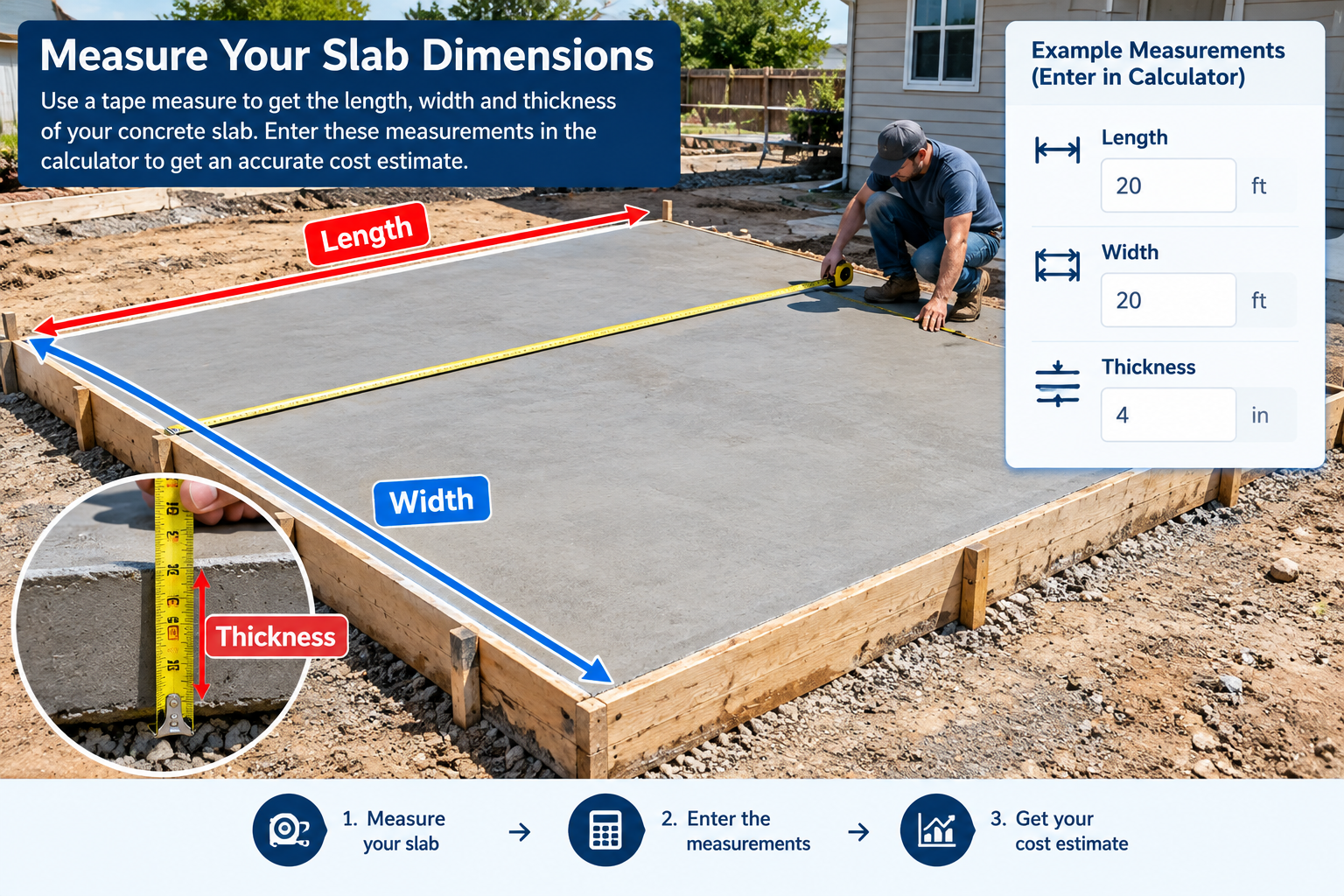
If you are looking for a cost for concrete slab calculator, enter your project measurements and cost details to get a quick estimate. To estimate your concrete slab cost, enter the required measurements and pricing information supported by the calculator.
Enter the Slab Length
Enter the total length of your slab using the measurement unit supported by the calculator.
For example, if your concrete slab is 20 feet long, enter 20 in the length field.
Enter the Slab Width
Enter the width of your slab using the same unit selected for the length.
For example, a concrete slab measuring 20 feet by 20 feet has a total surface area of 400 square feet.
Enter the Slab Thickness
Slab thickness is important because two slabs with the same surface area can require different amounts of concrete.
For example, a 4-inch slab and a 6-inch slab covering the same 400 square feet will have different concrete volumes. Enter your planned or specified thickness rather than estimating it from the project cost.
In addition, the appropriate thickness depends on the slab’s intended use, expected loads, soil conditions, design requirements, and applicable building codes.
Enter the Number of Slabs
If you are estimating multiple identical slabs, enter the total quantity if the calculator provides a quantity field.
For example, if you need three identical 10 × 10-foot concrete slabs, the combined surface area will be 300 square feet.
If the slabs have different dimensions or thicknesses, calculate them separately unless the tool supports different measurements for each slab.
Add a Waste Allowance
In practice, concrete projects may require extra material to account for measurement differences, spillage, uneven surfaces, and ordering requirements.
If the calculator includes a waste percentage field, enter an appropriate allowance for your project. A percentage such as 5% or 10% can be used for estimating, but the appropriate amount depends on site conditions and supplier requirements.
For example, an 8% waste allowance means multiplying the raw concrete volume by 1.08.
Enter the Concrete Price
Use a current price from your concrete supplier. In the United States, ready-mix concrete is commonly priced by the cubic yard.
Make sure the price you enter matches the unit used by the calculator. If the calculator uses a price per cubic yard, do not enter a price per bag or per cubic foot without converting it first.
However, local pricing can vary depending on the concrete mix, supplier, delivery distance, order size, and other charges.
Enter Labor and Other Costs
If the calculator provides fields for labor and additional expenses, enter the estimated costs that apply to your project.
These may include site preparation, reinforcement, formwork, finishing, delivery, equipment, demolition, and other project expenses.
Only include costs in the calculator fields that are actually available. If an expense has no dedicated input, account for it separately when preparing your overall budget.
How Is Concrete Slab Cost Calculated?
The calculation begins with the slab’s surface area and concrete volume. For a rectangular slab, multiply its length by its width to determine the area.
Area = Length × Width
Next, multiply the area by the slab thickness to calculate the volume. When the dimensions are measured in feet, the thickness must also be converted to feet to calculate the volume in cubic feet.
Volume in Cubic Feet = Area × Thickness in Feet
Since ready-mix concrete in the United States is commonly priced by the cubic yard, convert the volume from cubic feet to cubic yards.
Cubic Yards = Cubic Feet ÷ 27
Next, add the waste allowance. Convert the waste percentage into a decimal before using the formula.
Order Volume = Raw Volume × (1 + Waste Percentage)
For example, an 8% waste allowance is written as 0.08. Therefore, the multiplier is 1.08.
The estimated concrete material cost is calculated by multiplying the order volume by the supplier’s price per cubic yard.
Concrete Cost = Order Volume × Price per Cubic Yard
Finally, add the other applicable project expenses to estimate the total project cost.
Total Project Cost = Concrete Cost + Labor + Other Applicable Costs
Other costs may include site preparation, reinforcement, formwork, finishing, delivery, equipment, demolition, and additional expenses. Include these amounts according to the inputs available in your calculator and the requirements of your project.
This method separates the concrete material estimate from the other project expenses, making it easier to review and adjust your budget.
Concrete Slab Cost Example
Suppose you want to estimate the concrete requirements and material cost for two identical rectangular slabs with the following measurements:
- Length: 24 feet
- Width: 16 feet
- Thickness: 5 inches
- Quantity: 2 slabs
- Waste allowance: 8%
Calculate the Total Area
First, calculate the area of one slab.
24 × 16 = 384 square feet
Since there are two identical slabs:
384 × 2 = 768 square feet
The combined surface area is 768 square feet.
Convert the Thickness to Feet
Convert the 5-inch thickness into feet.
5 ÷ 12 = 0.4167 feet
Calculate the Raw Concrete Volume
Multiply the total area by the thickness in feet.
768 × 0.4167 ≈ 320 cubic feet
Convert Cubic Feet to Cubic Yards
One cubic yard equals 27 cubic feet.
320 ÷ 27 ≈ 11.85 cubic yards
The raw concrete volume is approximately 11.85 cubic yards.
Add the Waste Allowance
An 8% waste allowance uses a multiplier of 1.08.
11.85 × 1.08 ≈ 12.80 cubic yards
The estimated order volume is approximately 12.8 cubic yards of concrete.
Calculate the Concrete Material Cost
Suppose your supplier quotes $165 per cubic yard.
12.80 × $165 = $2,112
The estimated concrete material cost is approximately $2,112.
Keep in mind that this example covers concrete material only. The total project cost may be higher after adding labor, site preparation, reinforcement, formwork, finishing, delivery, equipment, and other applicable expenses. Actual supplier quantities and prices may also differ due to rounding, minimum-order requirements, and local conditions.
How Much Does Concrete Cost Per Square Foot?
Concrete slab cost per square foot helps you compare the average cost of projects with different sizes. However, the total depends on whether you are calculating concrete material costs alone or the complete project cost, including materials and labor. The national average can vary by location, slab thickness, project type, and installation requirements, so there is no single price that applies to every job.
To calculate the total project cost per square foot, divide the total project cost by the total slab area.
Total Project Cost Per Square Foot = Total Project Cost ÷ Total Slab Area
For example, suppose a concrete slab project costs $6,300 and covers 700 square feet.
$6,300 ÷ 700 = $9 per square foot
The estimated total project cost is therefore $9 per square foot.
For comparison, a project priced at $12 per square foot would cost approximately $8,400 for a 700-square-foot slab. This is an illustrative calculation, not a confirmed national average. Actual average concrete costs depend on local prices, site preparation, reinforcement, finishing, delivery, and labor.
Remember that the cost per square foot represents the average cost across the entire slab area. It does not mean every square foot has the same individual material or labor cost. Delivery, setup, and other fixed expenses can affect smaller projects disproportionately.
How Does Slab Thickness Affect Concrete Cost?
A thicker slab requires more concrete for the same surface area because concrete volume increases in direct proportion to thickness.
The following table compares the concrete volume required at different thicknesses, using a 4-inch slab as the baseline.
| Slab Thickness | Concrete Volume Compared With a 4-Inch Slab |
|---|---|
| 3 inches | 75% |
| 4 inches | 100% |
| 5 inches | 125% |
| 6 inches | 150% |
| 8 inches | 200% |
These percentages illustrate the mathematical relationship between slab thickness and concrete volume. They are not recommendations for choosing a slab thickness.
The appropriate thickness depends on the intended use, expected loads, soil conditions, reinforcement, design specifications, and applicable building requirements. Confirm the required slab design before ordering concrete.
Concrete Slab Cost by Size
The surface area of a rectangular slab is calculated by multiplying its length by its width. The following examples show the area of common slab dimensions.
| Slab Dimensions | Total Area |
|---|---|
| 8 × 12 feet | 96 sq. ft. |
| 10 × 14 feet | 140 sq. ft. |
| 12 × 16 feet | 192 sq. ft. |
| 15 × 20 feet | 300 sq. ft. |
| 18 × 24 feet | 432 sq. ft. |
| 20 × 25 feet | 500 sq. ft. |
Surface area alone does not determine the final concrete requirement or project cost. Thickness, waste allowance, local concrete prices, labor, site preparation, and other expenses also matter.
Use the Concrete Slab Cost Calculator to estimate the concrete quantity and, where supported, calculate the associated project costs using your own measurements and prices.
A 50×100 concrete slab covers 5,000 square feet. The 50×100 concrete slab cost will depend on the slab thickness, concrete price, labor, site preparation, delivery, reinforcement, and finishing. If you are planning a slab this size, enter your measurements and current project costs in the calculator above to get a more useful estimate for your project.
For a 500-square-foot slab, the total concrete cost depends on the slab thickness and local concrete prices. You should also factor in labor, delivery, material waste, and any site preparation needed before pouring.
What Is Included in Concrete Slab Cost?
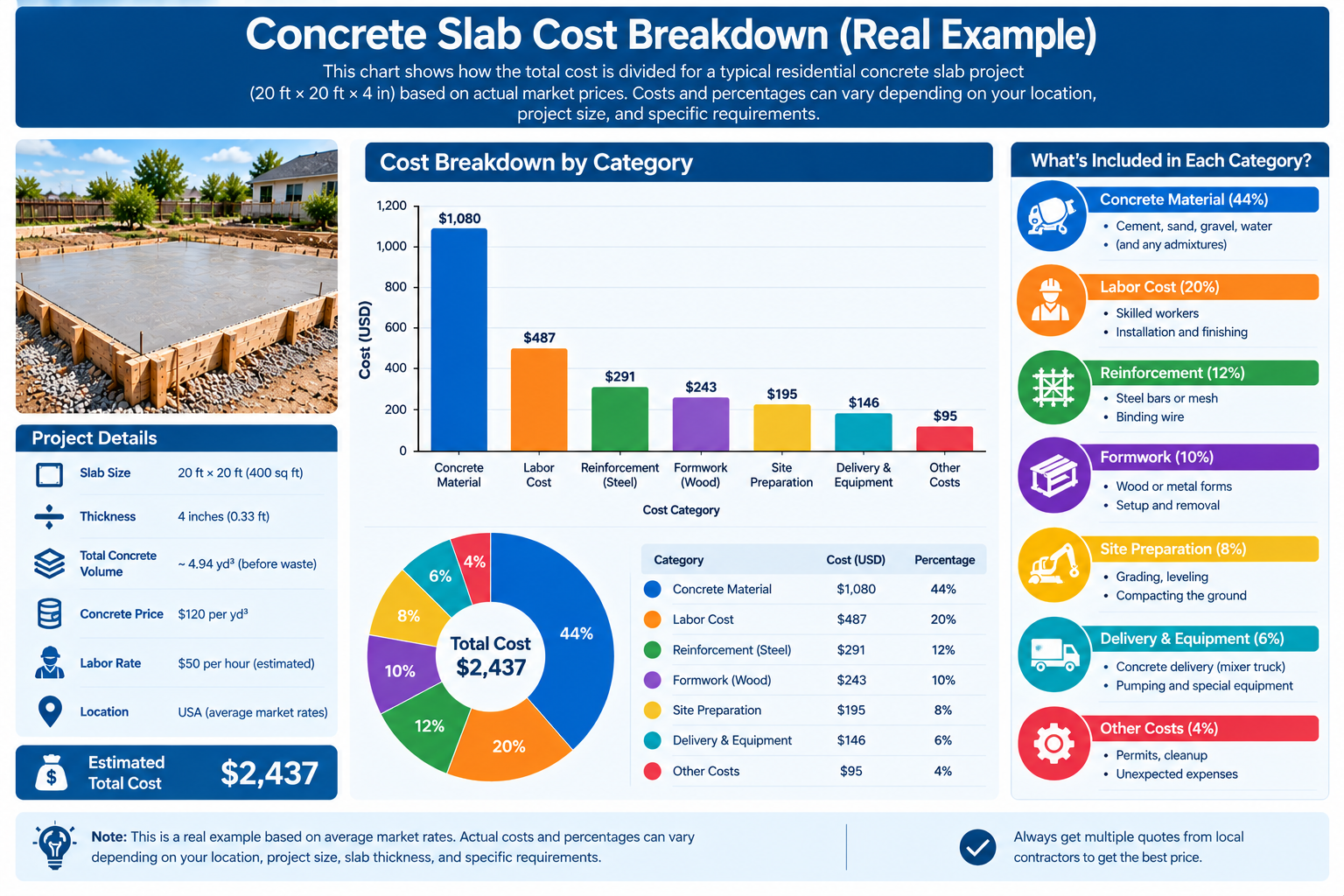
A complete concrete slab project can involve several expenses beyond the concrete itself. Understanding these cost categories can help you prepare a more realistic budget.
Concrete
Concrete is one of the main material expenses in a slab project. The amount required depends primarily on the slab’s area, thickness, and waste allowance.
In addition, the price per cubic yard can vary according to the concrete mix, required strength, supplier, location, delivery distance, and order size.
Labor
Labor costs may cover several stages of concrete slab installation, including:
- Site preparation
- Form installation
- Reinforcement installation
- Concrete placement
- Screeding
- Floating
- Edging
- Jointing
- Finishing
Labor rates can vary depending on the local market, slab size, site conditions, and complexity of the work.
Contractors may price labor by the cubic yard, square footage, hourly rate, or overall project. These differences can affect the total cost of materials and labor.
Site Preparation
Site preparation may involve:
- Excavation
- Grading
- Leveling
- Removing vegetation
- Compacting the ground
- Preparing the base
For projects that require a crushed stone base, use our Crushed Stone Calculator to estimate the amount of material needed based on the project area and required depth.
Reinforcement
Depending on the slab design and intended use, reinforcement may include:
- Rebar
- Welded wire mesh
- Fiber reinforcement
- Other reinforcement systems
The type and amount of reinforcement should be determined by the project’s design and structural requirements. Rebar and wire mesh can help control crack development when properly specified and installed, but they do not guarantee that a concrete slab will never crack. The associated cost may include both materials and installation labor.
Depending on site conditions and design requirements, a vapor barrier may also be installed beneath the concrete slab to help reduce moisture movement from the ground. This may be particularly relevant for certain indoor concrete floors and other slabs where moisture control is important.
Formwork
Forms hold wet concrete in the required shape while the slab is placed and finished.
A simple rectangular slab may need straightforward formwork. Irregular shapes, steps, elevation changes, and complex edges can increase material and labor costs.
Finishing
Finishing costs depend on the desired appearance and surface treatment. Common options include:
- Broom finish
- Smooth finish
- Exposed aggregate
- Stamped concrete
- Decorative finishes
- Staining
Concrete patios and other concrete surfaces may use basic or decorative finishes depending on their intended appearance and use. Specialized finishes may require additional materials, labor, equipment, or installation techniques, increasing the overall project cost.
Delivery
Ready-mix concrete may involve delivery-related fees beyond the advertised material price.
Depending on the supplier, additional charges may include:
- Delivery fees
- Minimum-order fees
- Short-load charges
- Distance-related charges
- Other supplier fees
These charges can be particularly important for smaller slab projects, where fixed delivery costs represent a larger share of the overall budget.
Pump and Equipment
A concrete pump or other specialized equipment may be necessary when a concrete truck cannot reach the placement area directly.
Equipment costs depend on the type of equipment required, site accessibility, and the time needed to complete the work.
Demolition and Removal
Replacing an existing concrete slab may involve additional expenses for:
- Concrete demolition
- Removal
- Hauling
- Disposal
- Additional site preparation
Include these expenses when estimating the budget for a slab replacement project.
What Factors Affect Concrete Slab Cost?
Several factors can influence the final cost of a concrete slab.
Slab Size
A larger slab typically requires more concrete. It may also need more labor, preparation, reinforcement, and finishing, depending on the project.
Slab Thickness
Increasing slab thickness increases the concrete volume required for the same surface area. It can also affect reinforcement and other construction requirements.
Concrete Mix
Different projects may require different concrete specifications. The selected mix and required strength can affect the material price.
Location
Concrete and construction costs vary by market. Local labor rates, supplier pricing, taxes, transportation, and material availability can all influence the final cost.
Site Conditions
An accessible, level site is generally easier to work on than a site with difficult access, steep slopes, or other complications. As a result, difficult conditions may increase labor, preparation, transportation, and equipment costs.
Reinforcement
Rebar, wire mesh, fiber, and other reinforcement systems can increase material and installation costs. The required reinforcement depends on the slab design and intended use.
Ground PreparationGround Preparation
The existing ground may require excavation, grading, leveling, compaction, or a properly prepared base before concrete placement. The amount of work required can substantially affect the total project cost.
If your project site has low spots or uneven ground that needs to be raised before preparing the concrete base, our Fill Dirt Calculator can help you estimate how much soil you’ll need.
Delivery Distance
The distance between the concrete supplier and the job site can affect transportation charges. Confirm the delivered price with your supplier instead of relying only on the advertised price per cubic yard.
Minimum Order Requirements
Concrete suppliers may have minimum order quantities or additional charges for smaller orders. Minimum-order fees and short-load charges can have a noticeable impact on smaller projects.
Surface Finish
The selected surface finish can affect the final cost. Decorative and specialized finishes generally require more materials, labor, or specialized installation than a basic finish.
Existing Concrete
Replacing an existing slab can add demolition, hauling, disposal, and site-preparation expenses. These costs should be considered when estimating the budget for a replacement project.
Ready-Mix Concrete vs. Bagged Concrete
Choosing between ready-mix and bagged concrete depends on the project’s size, access, labor requirements, and overall needs.
Ready-Mix Concrete
Ready-mix concrete is delivered to the project site in a ready-to-use condition.
It can be practical for larger slabs because a substantial quantity can be delivered and placed efficiently. However, the total cost may include the concrete itself, delivery, minimum-order charges, and other supplier fees.
Before ordering, confirm the required quantity, delivery schedule, truck access, and any additional charges with the supplier.
Bagged Concrete
Bagged concrete comes in individual bags and is mixed on-site. It can be suitable for small repairs and projects where ready-mix delivery is impractical.
For larger slabs, mixing many bags can require considerable time, labor, and equipment. Compare the total material and labor costs rather than looking only at the price of an individual bag.
When estimating bagged concrete requirements, use the actual yield stated on the product packaging. Bag yields vary by product and bag size, so a generic bag count may produce an inaccurate estimate.
How Much Concrete Do I Need?
The length, width, and thickness of a slab determine its basic concrete volume. To calculate the volume correctly, use consistent units and convert the final result into the unit you need.
For a rectangular slab:
Volume = Length × Width × Thickness
When the length and width are in feet and thickness is in inches, convert the thickness to feet before calculating the volume in cubic feet. Then divide the cubic-foot result by 27 to convert it to cubic yards.
For example, a 10 × 12-foot slab that is 4 inches thick has:
- Area: 120 square feet
- Raw concrete volume: Approximately 1.48 cubic yards
A 12 × 14-foot slab at 4 inches thick requires approximately 2.07 cubic yards before waste.
An 18 × 20-foot slab at 4 inches thick requires approximately 4.44 cubic yards before waste.
These figures represent theoretical volumes. Add an appropriate waste allowance when estimating the amount to order, and confirm the final quantity with your concrete supplier.
Concrete Slab Cost for Common Projects
Concrete slabs are used for many residential and commercial purposes. The design, required thickness, site conditions, and finishing requirements can vary by application.
Patio Slab
Patios can be relatively straightforward projects, but decorative finishes, unusual shapes, steps, drainage requirements, and difficult site access can increase the overall cost.
Driveway Slab
Driveways must be designed for vehicle traffic and expected loads rather than typical pedestrian use.
The appropriate slab thickness, reinforcement, base preparation, joints, and other requirements depend on the intended use and applicable design requirements.
Garage Slab
Garage floors may require additional preparation, reinforcement, and design considerations based on the structure and expected loads.
Concrete garage floors may require a suitable slab thickness, proper base preparation, and reinforcement based on the expected vehicle loads and project design. The cost per square foot can also vary depending on concrete prices, labor, and the selected surface finish. Before pouring concrete, confirm the required specifications and include any applicable preparation and finishing expenses in your estimate.
Shed or Building Pad
A small slab may require relatively little concrete, but fixed expenses such as delivery, setup, and equipment can make its cost per square foot higher.
Walkway
Walkways generally require less concrete than larger slabs. However, excavation, formwork, curves, unusual shapes, site access, and finishing can still affect the final cost.
What Does the Concrete Slab Cost Calculator Include?
The calculator’s available features depend on the inputs and calculations implemented in the tool. Depending on those features and the information entered, it may estimate:
- Total slab area
- Raw concrete volume
- Concrete volume with waste
- Required cubic yards
- Concrete material cost
- Labor cost, if supported
- Additional project costs, if supported
- Total estimated project cost
- Total project cost per square foot, if supported
The calculator can help with basic material estimates and project budgeting. However, only rely on a specific cost breakdown if the tool actually calculates it using the available inputs.
What Is Not Automatically Included?
A Concrete Slab Cost Calculator provides an estimate based on the measurements and costs entered. It cannot automatically account for every condition or expense at a job site.
Unless these expenses are included through the calculator’s inputs or added separately, your estimate may not cover:
- Permits
- Engineering
- Special inspections
- Taxes
- Unexpected excavation
- Poor-soil remediation
- Drainage improvements
- Utility relocation
- Difficult site access
- Special concrete mixes
- Contractor overhead
- Unexpected price changes
These costs vary by project and location. Review the calculator’s inputs and results carefully, and add any relevant expenses that are not included.
Why Is a Contractor’s Concrete Slab Quote Different?
A calculator generates an estimate using the information you provide. A contractor can inspect the actual project and account for conditions or services that may not be represented in the calculator.
For example, a contractor’s quote may include:
- Site inspection
- Mobilization
- Project supervision
- Equipment
- Insurance
- Overhead
- Profit
- Permits
- Disposal
- Additional preparation
- Difficult site access
- Project-specific requirements
Contractors may also receive different prices from material suppliers, which can affect the final project cost.
For these reasons, use the calculator as a planning and budgeting tool rather than as a guaranteed contractor quote. Compare your estimate with current quotes from local concrete suppliers and qualified contractors.
Common Concrete Slab Cost Estimation Mistakes
Avoiding common estimation mistakes can help you prepare a more realistic concrete slab budget.
Forgetting to Include Waste
The theoretical concrete volume may not match the exact amount required at the job site.
Include an appropriate waste allowance based on your measurements, site conditions, and supplier requirements.
Using the Wrong Thickness
Even a small change in slab thickness can affect the amount of concrete required.
Double-check the planned thickness before estimating the concrete volume or placing an order.
Overlooking Delivery Costs
The advertised price per cubic yard may not include the full cost of delivery.
Ask your supplier about delivery charges, minimum-order requirements, short-load fees, and other applicable costs.
Forgetting Site Preparation
Excavation, grading, compaction, and base preparation can be important parts of a concrete slab project.
Do not assume that the concrete material cost represents the entire project cost.
Overlooking Reinforcement
Rebar, welded wire mesh, fiber, and other reinforcement systems can increase material and installation costs when required by the slab design.
Comparing Concrete Prices Alone
A supplier with a lower price per cubic yard may not have the lowest delivered cost once delivery charges and other fees are included.
For this reason, compare the total delivered cost and confirm that the quotes cover comparable concrete specifications and quantities.
Treating the Calculator as a Contractor Quote
An online calculator cannot evaluate every site condition or project requirement.
Use the estimate as a starting point, then compare it with current prices from local concrete suppliers and contractors.
FAQs
How do I estimate the cost of a concrete slab?
Calculate the slab’s area, determine the concrete volume based on thickness, add an appropriate waste allowance, and multiply the order volume by your local price per cubic yard. The Concrete Slab Cost Calculator can help you work through these calculations and estimate the total cost. Then add labor, site preparation, reinforcement, delivery, finishing, and other applicable costs.
How much concrete do I need for a 12 × 12 slab?
A 12 × 12-foot slab has an area of 144 square feet. At 4 inches thick, it requires approximately 1.78 cubic yards of concrete before waste.
How much concrete does a 15 × 20 slab require?
A 15 × 20-foot slab has an area of 300 square feet. At 4 inches thick, it requires approximately 3.70 cubic yards of concrete before waste.
How much extra concrete should I order?
The appropriate waste allowance depends on the project and site conditions. A percentage such as 5% or 10% may be used for estimating, but actual measurements, uneven surfaces, and supplier requirements should also be considered.
Does slab thickness affect concrete cost?
Yes. A thicker slab requires more concrete for the same surface area, which increases material costs. It may also affect reinforcement and other project expenses, depending on the design.
Is ready-mix concrete sold by the cubic yard?
In the United States, ready-mix concrete is commonly priced and sold by the cubic yard. Bagged concrete is sold by the bag, with the expected yield listed on the product packaging.
Can I include labor in the calculator?
You can include labor if the calculator provides a labor input. Enter the estimated labor cost according to the field’s instructions. If no labor input is available, add the cost separately to your project budget.
Can the calculator include reinforcement?
The calculator can account for reinforcement costs if it provides a suitable input. Otherwise, estimate those expenses separately using the materials and installation costs applicable to your project.
Why is my contractor’s quote higher than the calculator estimate?
A contractor’s quote may include expenses that are not covered by your calculator inputs, such as site preparation, mobilization, equipment, permits, disposal, overhead, profit, difficult access, and project-specific work. Differences in local pricing and project requirements can also affect the final quote.
Can I use the calculator with metric measurements?
You can use metric measurements if the calculator supports metric inputs. Check the available measurement units before entering your dimensions. If the tool does not support metric units, convert your measurements to the units it accepts.
Can I calculate multiple slabs?
If the calculator provides a quantity field, you can use it to estimate multiple identical slabs by entering the number of slabs. If the slabs have different dimensions or thicknesses, calculate them separately unless the tool supports different measurements for each slab.
Is a concrete slab calculator the same as a contractor quote?
No. The Concrete Slab Cost Calculator provides an estimate based on the information and costs entered. Actual project costs depend on local material prices, labor rates, site conditions, specifications, and other project requirements.
Final Takeaway
Calculate the slab’s area, determine the concrete volume based on thickness, add an appropriate waste allowance, and multiply the order volume by your local price per cubic yard. The Concrete Slab Cost Calculator can help you work through these calculations and estimate the total cost. Then add labor, site preparation, reinforcement, delivery, finishing, and other applicable costs.